DOMES OF BUCKMINSTER FULLER AND HIS FOLLOWERS IN CONTEMPORARY DOME PAVILION DESIGN
The Influence of Buckminster Fuller’s Domes on Modern Design
From Symbolic Domes to Functional Design
Until the late 19th century, domes often symbolized religion and state power. They crowned cathedrals, temples, and government buildings. In modern architecture, their role has shifted. Today, domes usually serve practical and utilitarian purposes. Yet some 20th-century structures combine utility with deep philosophical meaning and innovative scientific thinking.
Few architects embody this union better than Buckminster Fuller. His ideas reshaped architecture and engineering in the mid-1900s, and their influence continues to inspire designers worldwide.
The Birth of the Geodesic Dome
In the 1960s, Fuller became world-famous for creating the geodesic dome. This structure combined light weight, exceptional strength, and economic efficiency. The larger the dome, the greater the cost savings.
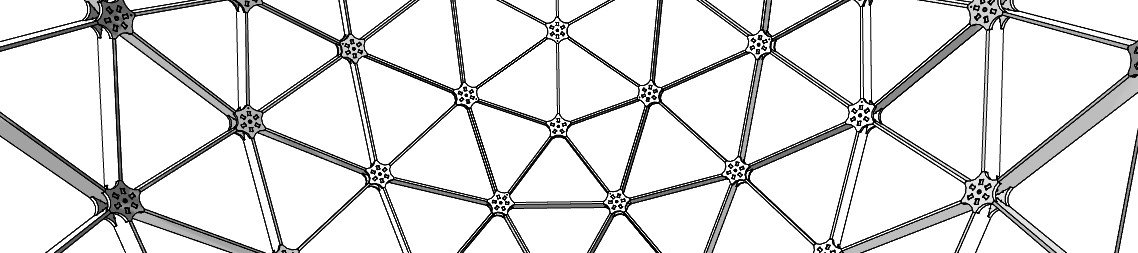
Fuller’s concept grew out of his research in cartography. He studied how to project the Earth’s curved surface onto a flat map with minimal distortion. Traditional projections like the Mercator map distorted shapes near the poles. In 1942, Fuller patented a new projection method. He represented the globe as an icosahedron, a twenty-faced polyhedron made of equilateral triangles. When unfolded, it maintained true proportions across the surface. This geometric insight later inspired the structure of his domes.
By 1947, Fuller began building hemispherical frameworks from triangular modules. These lightweight yet rigid forms could span large spaces without internal supports. They were so strong that some could resist hurricane-level winds of up to 210 miles per hour.
Fuller’s Early Projects and Global Recognition
Fuller built his first dome in 1952 in Woods Hole, Massachusetts. It measured about 60 feet across and served a small restaurant. Despite some issues with insulation and durability, it proved his concept worked.
One year later, he designed another dome for Ford Motor Company in Dearborn, Illinois. With a diameter of 83 feet and a weight of 8.5 tons, it drew attention from engineers and journalists alike. This success made Fuller a household name.
By the early 1960s, the U.S. government began supporting his research. One early result was the “Golden Dome”, built for the 1959 American National Exhibition in Moscow. It housed displays of American art and technology during the height of the Cold War.
The Montreal Pavilion and Fuller’s Legacy
Fuller’s most famous project, the U.S. Pavilion at Expo ’67 in Montreal, reached 250 feet in diameter. Its transparent acrylic panels enclosed several floating platform levels, creating a sense of weightlessness and cosmic space. In 1968, the American Institute of Architects awarded Fuller for this groundbreaking design.
The dome’s geometry came from the same icosahedral model Fuller used in his cartographic studies, but refined into smaller triangular segments. The result was both functional and poetic — a structure that represented the universe itself.
Geodesic Domes in Modern Architecture
Fuller’s influence didn’t fade with time. More than 300,000 geodesic domes have been built worldwide. They serve as hangars, exhibition halls, homes, and research stations. Even NASA considers this geometry ideal for future habitats on the Moon and Mars.
Modern Examples
-
The Climatron, St. Louis, USA (1960): A botanical conservatory that remains an engineering icon.
-
The Eden Project, Cornwall, UK (2001): A group of biomes by Nicholas Grimshaw, housing thousands of plants.
-
Roskilde Dome, Denmark (2012): Designed by Kristoffer Tejlgaard for the Roskilde Festival, inspired by the carbon-240 Fullerene molecule.
-
Jeddah Superdome, Saudi Arabia (2021): The world’s largest continuous dome, spanning about 690 feet (210 meters).
-
Modern Glamping Domes: Sustainable off-grid living structures now popular in eco-villages worldwide.
From Molecular Science to Sustainable Architecture
In 1985, scientists discovered new carbon molecules shaped like tiny domes. They named them fullerenes in honor of Buckminster Fuller. These molecules inspired research in nanotechnology and advanced materials that combine strength, lightness, and flexibility — echoing the same principles behind his architecture.
Continuing the Tradition at Fancy Structure
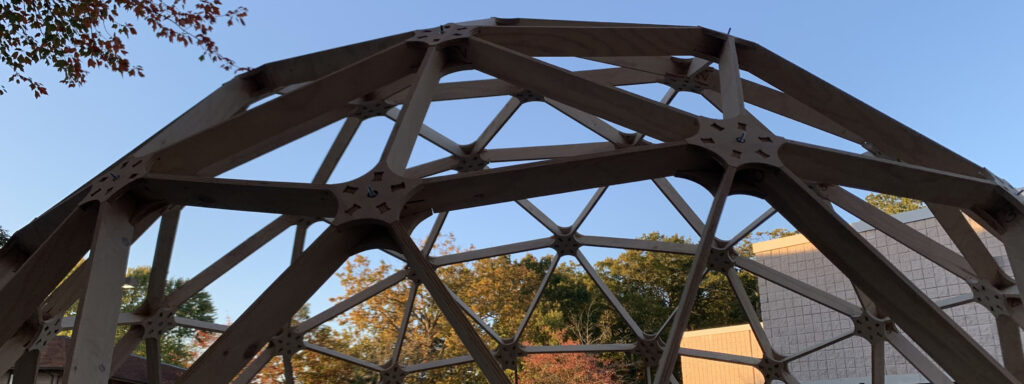
At Fancy Structure, we carry Fuller’s legacy forward. Our team designs and produces modern geodesic domes from CNC-cut plywood and engineered wood. By merging digital precision with natural materials, we create durable, eco-friendly, and elegant spaces for homes, pavilions, and outdoor events.
Each dome celebrates Fuller’s timeless vision — simplicity, strength, and harmony with nature.

Related Posts
FANCY STRUCTURE at the NJ Home & Garden Show 2026 in Edison
Geometry of Strength: Triangulated Structures